

Autonomy of the grounds for invalidation and scope of the examination of bad faith in CJEU judgment C-17/24
1.Facts of the case
CeramTec GmbH is proprietor of two EU trademarks depicting pink ceramic medical components used in particular in hip or knee implants and of an EU trademark consisting of the colour pink (Pantone 677C).

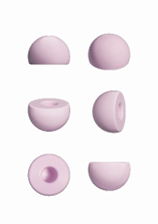
 (EUTM 010214112, EUTM 010214179 and EUTM 010214195).
They were filed in 2011, i.e. at a time when the original patent for the technology for colouring the above-mentioned components had expired. The pink shade was merely a side effect caused by the addition of chromium oxide, which, according to CeramTec, had an important technical function, ensuring increased hardness and strength of the components. However, after the expiry of the patent and the registration of the trademarks, the proprietor discovered that chromium oxide did not in fact have any technical effect.
In a pending dispute with CeramTec, Coorstek Bioceramics LLC filed a counterclaim for invalidity of the above trademarks, alleging bad faith. It pointed out that CeramTec’s objective at the time of filing the disputed trademarks wasn’t really to prevent competitors from continuing to use the pink colour as to prevent competitors from using chromium oxide in the right proportion to increase the strength of the implants.
2.Legal issue
The French Court of Appeal invalidated the above trademarks, stating that the proprietor intended to obtain exclusive rights for purposes other than those related to the function of a trademark. CeramTec was convinced of the technical nature of the pigment, and the application was intended to maintain market exclusivity despite the expiry of patent protection. The proprietor filed an appeal.
The referring court asked the Court of Justice whether the premises for invalidity of a trademark on the grounds of its exclusively technical nature and bad faith are autonomous or mutually exclusive. The referring court also seeks to determine how and on what basis the bad faith of the applicant should be assessed, i.e. whether it is sufficient to demonstrate a subjective belief in the technical nature of the mark and whether the bad faith of the applicant can be assessed on the basis of circumstances that arose after the application was filed.
3.CJEU judgment
The Court of Justice pointed out that the two grounds for invalidity relating exclusively to the technical nature of the mark and to bad faith have separate objectives and may be applied simultaneously. It is therefore not necessary to exhaust one of them first, and the courts and offices may examine both the technical nature of the mark and the applicant’s intentions.
The CJEU then recalled that the intention of the trademark applicant is a subjective element which must, however, be determined objectively by the competent administrative and judicial authorities. Consequently, any allegation of bad faith must be assessed as a whole, taking into account all the relevant facts of the case. In this regard, the CJEU pointed out that it is necessary to take into account factors such as the nature of the contested trademark, the origin of the mark in question and its use since its creation, the scope of the expired patent, the commercial logic underlying the registration of the contested trademark, and the chronology of events that influenced that registration. The applicant’s belief that the mark has a technical function should therefore also be taken into account, even if it later proved to be incorrect.
The CJEU also recalled that the assessment of bad faith must be made on the basis of all the facts. It emphasised that circumstances that arose even after the application was filed should also be taken into account if they can be used as an indication of the applicant’s intention at the time of the application.
4.Summary
The judgment confirms the existing case law and the autonomous nature of bad faith in relation to other grounds for invalidity of a trademark. In light of this ruling, it is also worth noting that even if the colour pink was only a secondary effect of the use of chromium oxide – intended to ensure the durability of the products – this does not preclude the possibility that it may in itself function as a trademark. However, when assessing the existence of bad faith, it will be crucial to examine the applicant’s state of mind. The French court will be required to take into account, in particular, the factors identified by the CJEU, such as the commercial logic behind the registration of the disputed marks and the applicant’s belief in the technical function of chromium oxide, even if this belief later proved to be incorrect.
full text of the judgment: https://curia.europa.eu/juris/document/document.jsf?mode=lst&pageIndex=0&docid=301355&part=1&doclang=EN&text=&dir=&occ=first&cid=5772347

See more:
From the Turing Test to the 2024 Nobel Prize: How Artificial Intelligence Has Developed Over the Decades
From the Turing Test to the 2024 Nobel Prize: How Artificial Intelligence Has Developed Over the Decades This is the first article in a series of publications devoted to artificial intelligence. As a starting point, it is worth setting out the key stages in the...
Overview of CJEU case law from 2.03 to 13.03.2026
Kowalski v EUIPO – Hoyer (FLAMBIT – flambriks), Case T‑301/25– The case concerned opposition proceedings against the registration of an EU trade mark. – Mr Dariusz Kowalski filed an application for the registration of the following EU figurative sign FLAMBIT for goods...
Overview of CJEU case law from 16.02 to 27.02.2026
Opinion of Advocate General – 26 February 2026 – Verwertungsgesellschaft Wort (VG Wort) v TL, Case C‑840/24 – The request for a preliminary ruling was submitted by the Bundesgerichtshof (Federal Court of Justice, Germany) and concerns the interpretation of provisions...