

Review of CJEU case law from 19.01.2026 to 23.01.2026
Hesse v EUIPO – 19.01.2026 – Ferrari (TESTAROSSA), Case C‑597/25 P
– The case concerned the procedure under Article 58a of the Statute of the Court of Justice for determining whether an appeal against a judgment of the General Court in EU trade mark proceedings should be allowed to proceed.
– Mr Kurt Hesse filed an appeal seeking to set aside the judgment of the General Court of 2 July 2025 in Case T‑1103/23 (TESTAROSSA), which annulled the decision of the Fifth Board of Appeal of EUIPO in joined revocation proceedings concerning the TESTAROSSA trade mark.
– Pursuant to Article 58a of the Statute and Articles 170a–170b of the Rules of Procedure, the appellant must annex to the appeal a request demonstrating that the appeal raises an issue significant for the unity, consistency or development of EU law.
– The appellant submitted that each of the five grounds of appeal raised such significant issues. He relied, inter alia, on alleged errors by the General Court in its interpretation of Article 18(1) and (2) of Regulation 2017/1001 concerning genuine use, in particular the requirements for unequivocal consent of the trade mark proprietor in cases involving resale of used vehicles, spare parts and accessories.
– He further argued that the General Court misinterpreted the case-law on whether use in relation to spare parts may constitute genuine use for the main product category, and that the General Court wrongly assessed the Board of Appeal’s exercise of discretion under Article 95(2) of Regulation 2017/1001 when admitting or excluding evidence.
– The Court held that the appellant had failed to demonstrate that his grounds of appeal raised any issue significant for the unity, consistency or development of EU law. It observed that the arguments concerning Article 18(1) and (2) in reality sought a reassessment of factual findings and evidence, which cannot justify allowing an appeal to proceed within the meaning of Article 58a.
– The Court noted that allegations of infringement of case-law must be substantiated by identifying not only the conflicting passages but also the specific reasons why the alleged conflict raises an issue significant for EU law. While the appellant specified the contested paragraphs and the case-law invoked, he did not provide any explanation demonstrating the significance required by Article 58a.
– The Court added that the appellant’s reference to issues not yet addressed by the Court was insufficient. The mere fact that a legal question is novel does not, without further explanation, establish its significance under Article 58a.
– The Court concluded that the appellant had not complied with the requirements set out in Articles 170a–170b of the Rules of Procedure and the relevant case-law and therefore refused the request for the appeal to be allowed to proceed.
Case details: eur-lex.europa.eu/legal-content/EN/TXT/HTML/?uri=CELEX:62025CO0597
Judgment – 19.01.2026 – Hesse v EUIPO – Ferrari (TESTAROSSA), Case C‑598/25 P
– The case concerned the procedure under Article 58a of the Statute of the Court of Justice for determining whether an appeal against a judgment of the General Court relating to EU trade mark revocation should be allowed to proceed.
– The appeal sought to set aside the judgment of the General Court of 2 July 2025 in Case T‑1104/23, which annulled the decision of the Fifth Board of Appeal of EUIPO of 29 August 2023 to the extent that the contested mark was revoked for “scale toy land motor vehicles” in Class 28 (scale model vehicles).
– As in Case C‑597/25 P, the appellant submitted a request under Article 170a of the Rules of Procedure claiming that his grounds of appeal raised issues significant for the unity, consistency or development of EU law within the meaning of Article 58a of the Statute.
– The appellant put forward two grounds of appeal. First, he argued that the General Court failed to apply the high evidentiary threshold required to prove genuine use for scale model vehicles and misinterpreted the primary function of the trade mark as a guarantee of commercial origin. He claimed that visibility of the mark on scale models, its size or references to licensing contracts were not sufficient proof.
– Second, the appellant argued that the General Court wrongly inferred implied consent under Article 18(2) of Regulation 2017/1001 for use of the trade mark by third-party manufacturers of scale model vehicles. He maintained that mere knowledge, tolerance or contractual links with licensees do not justify presuming consent.
– The Court held that the appellant failed to demonstrate that these issues raised any question significant for the unity, consistency or development of EU law. The Court noted that the appellant in reality sought a new assessment of facts and evidence, which cannot justify allowing an appeal to proceed under Article 58a.
– The Court reiterated, in terms nearly identical to those used in Case C‑597/25 P, that alleging misinterpretation of case-law is insufficient unless the appellant specifies clearly why the alleged contradiction would be significant for EU law. In this case, the appellant did not provide such reasons.
– The Court also repeated its finding from Case C‑597/25 P that novelty of an issue alone is insufficient to meet the Article 58a threshold; detailed justification of its significance is required, which the appellant failed to provide.
– Given the parallels with the earlier case: both appeals were brought by the same appellant, on the same day, concerning the same mark TESTAROSSA, and both challenged General Court judgments of 2 July 2025; in both cases, the Court found that the appeal effectively sought factual reassessment and did not raise questions significant for EU law. The legal reasoning applied is substantively identical.
– The Court therefore refused to allow the appeal to proceed.
Judgment – 21/01/2026 – Universal Brand Group Pty Ltd v EUIPO, Case T-561/24
– The case concerned proceedings concerning an opposition to the registration of a trademark.
– Universal Brand Group Pty Ltd had filed an EU figurative trademark application:

for goods in Classes 9 and 11 of the Nice Classification to the following description:
- Class 9: ‘Software for remote control and intelligent operation of heating apparatus for dispensing hot beverages and installations for heating beverages’;
- Class 11: ‘Heating apparatus for dispensing hot beverages; Installations for heating beverages; Coffee machines, electric; Coffee capsules, empty, for electric coffee machines’.
– Elon Group AB, filed a notice of opposition based on the earlier Swedish word mark ELON, covering goods in Classes 9 and 11 due to a likelihood of confusion in respect of those goods.
– The Opposition Division upheld the opposition for all contested goods (class 9 and 11), finding a likelihood of confusion under Article 8(1)(b) EUTMR.
– The Board of Appeal dismissed the following appeal, noting that the signs had a high degree of visual similarity and an at least above average degree of phonetic similarity and that the earlier trade mark had an average degree of inherent distinctiveness. It held that the conceptual differences between the signs at issue were not sufficient to exclude the existence of a likelihood of confusion.
– Regarding the comparison of signs, the Court upheld the Board of Appeal’s argument that the stylisation of the applied‑for mark was ornamental and that the word element dominated. The Court confirmed a high degree of visual similarity, given that both marks contained the sequences “el” and “on” in the same order, with the only difference being the additional letter “t” in the middle of “Elton”.
– As to conceptual similarity, the Court agreed that the applicant had not demonstrated that the average Swedish consumer would perceive Elon or “Elton” primarily as references to well‑known celebrities such as Elon Musk or Elton John but rather, they would be understood as ordinary first names or fanciful terms.
– The Court rejected the applicant’s claim that conceptual differences counteracted the visual and phonetic similarities. It held that neither of the names had a clear and specific meaning for the relevant public capable of neutralising the similarities.
– Additionally, the Court further argued that even a high level of consumer attention does not eliminate the likelihood of confusion when the marks and goods are highly similar.
– The Court found that there was a likelihood of confusion and dismissed the action in its entirety.
Case details: eur-lex.europa.eu/legal-content/EN/TXT/HTML/?uri=CELEX:62024TJ0561
Judgment – 21.01.2026 – Synonym Software, SA de CV v EUIPO (PAYKIT)
– The case concerned proceedings regarding the refusal to register the EU word mark PAYKIT on the basis of the absolute ground of descriptiveness.
– The application covered a broad range of software, financial and payment‑related goods and services in Classes 9, 36 and 42, including cryptocurrency payment processing, payment software, authentication tools, SaaS for payment interfaces.
– Registration was refused basing on the sign’s lack of descriptiveness and distinctiveness.
– The Board of Appeal dismissed Synonym Software’s appeal, stating that the relevant public (English‑speaking consumers and professionals with average to high attention) would perceive the elements “pay” and “kit” as a reference to a set of tools enabling payment transactions (thus finding the mark descriptive and non‑distinctive).
– The Board also noted that the applicant had raised an auxiliary claim of acquired distinctiveness, and therefore referred that aspect back to the examiner.
– The Court dismissed the applicant’s claim that EUIPO had misinterpreted the meaning of “pay” and “kit”. It confirmed that the relevant public would immediately recognise the two word elements and perceive PAYKIT as a toolkit for payment‑related functions.
– The Court held that the combination was linguistically normal, comparable to common English nouns, and did not produce a meaning beyond the sum of its descriptive components.
– The Court underscored that the Board of Appeal had correctly identified a sufficiently direct and specific link between the sign and all categories of goods and services, since they all concerned software, financial services, or platforms related to payment processing.
– As the mark was correctly found descriptive under Article 7(1)(c), the plea concerning distinctiveness under Article 7(1)(b) could not succeed.
– The General Court dismissed the action in its entirety.
Case details: eur-lex.europa.eu/legal-content/EN/TXT/HTML/?uri=CELEX:62025TJ0078
Judgment – 21.01.2026 – Casa Ermelinda Freitas–Vinhos v EUIPO – Eggers & Franke Holding (EF), Case T‑71/25
Casa Ermelinda Freitas – Vinhos v EUIPO – Eggers & Franke Holding (EF), Case T‑71/25
– The case concerned opposition proceedings against the registration of an EU figurative trade mark.
– Eggers & Franke Holding GmbH filed the following EU figurative mark consisting of a stylised combination of the letters “E” and “F” for goods in Class 32 (including beers, mineral and aerated waters, non‑alcoholic beverages, fruit drinks, juices, syrups and preparations for making beverages):

– Casa Ermelinda Freitas – Vinhos, S.A. opposed the application based on the earlier EU word mark EF – ERMELINDA FREITAS (No 13 625 728) for goods in Class 33 (“Alcoholic beverages (except beer)”), invoking Article 8(1)(b) of Regulation 2017/1001 (likelihood of confusion).
– The Opposition Division rejected the opposition; the applicant appealed.
– The Fifth Board of Appeal dismissed the appeal, finding no likelihood of confusion despite some similarity between the goods. It held that the signs were similar only to a low degree visually and phonetically, and conceptually not similar, because the earlier mark was dominated by the element “ERMELINDA FREITAS”.
– The General Court dismissed the action. It upheld the uncontested findings that the relevant public was the EU general public with an average degree of attentiveness and that the goods were partly similar (to an average or low degree) and partly dissimilar.
– Regarding the earlier sign, the Court confirmed that ERMELINDA FREITAS is the dominant element, forming a syntactical and conceptual unit of average distinctiveness, while “EF” functions as an ancillary element corresponding to the initials of the name.
– Regarding the contested mark, the Court found that it consists of stylised intertwined letters “E” and “F”. This stylisation is not trivial and contributes, albeit to a limited extent, to distinctiveness. Even if some consumers may perceive an additional connecting shape, the essential perception remains that of stylised letters “E” and “F”.
– Visually, the Court held that the overall impression of the earlier mark is dominated by ERMELINDA FREITAS, and that the stylisation of the letters in the applied‑for mark differentiates it significantly. The similarity is therefore low.
– Phonetically, the applied‑for sign would be pronounced “EF”, while the earlier sign would be pronounced “Ermelinda Freitas” or “EF Ermelinda Freitas”. Because the dominant verbal element ERMELINDA FREITAS has no equivalent in the contested mark, similarity is at most low. The Court rejected the argument that consumers would abbreviate the earlier mark to “EF”, noting no evidence or circumstances supporting such abbreviation.
– Conceptually, the Court found no relevant similarity: the earlier mark may be perceived as a first name and surname preceded by initials, whereas the applied‑for sign will be perceived simply as letters without a specific meaning. The applicant’s argument that some consumers might associate “EF” with the initials of the name was dismissed as unproven and irrelevant, as reputation cannot be used to alter the conceptual comparison.
– The distinctiveness of the earlier mark was normal.
– Applying the principle of interdependence, the Court held that the low visual and phonetic similarity, the absence of conceptual similarity and the dominance of ERMELINDA FREITAS in the earlier mark excluded any likelihood of confusion, even though part of the goods were similar.
– The Court therefore dismissed the action, ordering the applicant to pay the intervener’s costs, while EUIPO was to bear its own costs.
Case details: eur-lex.europa.eu/legal-content/EN/TXT/HTML/?uri=CELEX:62025TJ0071
Judgment – 21.01.2026 Puma v EUIPO – Ningbo Gongfang, Case T‑43/25
– The case concerned opposition proceedings against the registration of a figurative mark representing a curved stripe combined with an irregular triangle placed inside a black rectangle.
– Ningbo Gongfang Commercial Management Co. Ltd filed an application for the following EU figurative mark for goods in Class 25 (including jackets, sweaters, shirts, T‑shirts, footwear, and socks):

– Puma SE filed an opposition based on three earlier EU figurative marks consisting of one or more white curved stripes ascending to the right, all registered for goods in Class 25:
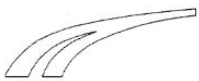


– The opposition was based on Article 8(1)(b) of Regulation 2017/1001 (likelihood of confusion).
– The Opposition Division rejected the opposition. Puma appealed.
– The Fourth Board of Appeal dismissed the appeal. It found that although the goods were identical and directed at the general public with average attention, the signs were visually dissimilar, since the earlier marks consisted exclusively of curved stripes ascending to the right on transparent backgrounds, while the contested mark combined a curved stripe with an inverted irregular triangle placed within a black rectangular background. As the signs were purely figurative, they could not be compared phonetically, and conceptually they conveyed no meaning. It therefore concluded that the signs were dissimilar overall.
– The General Court dismissed the action. It confirmed that the comparison must be made strictly on the basis of the signs as registered, and not on hypothetical orientations or on how the marks may appear when placed on goods. It rejected Puma’s argument that the mark could “rotate” or that the black background could “disappear” on dark goods, noting that such considerations are legally irrelevant.
– The Court agreed that visually the signs differ substantially: the earlier marks are composed of converging or parallel curved white stripes creating a narrowing motion to the right, while the contested mark combines a curved stripe with an inverted irregular triangle, producing an angular and segmented appearance. The presence of the black rectangle further enhances the differences.
– The Court confirmed that phonetic comparison is impossible, as the marks contain no pronounceable elements.
– Conceptually, the Court found that none of the signs conveys any identifiable meaning; they do not depict any object or concept. A conceptual comparison was therefore excluded.
– The Court held that because the signs are visually dissimilar and cannot be compared phonetically or conceptually, one of the cumulative conditions of Article 8(1)(b) (similarity of the marks) was not satisfied. The identity of the goods and the alleged increased distinctiveness of the earlier marks therefore could not outweigh the absence of similarity between the signs.
– The applicant’s arguments based on national court decisions, alleged use conferring enhanced distinctiveness, or the existence of a “family of marks” consisting of stripes, were rejected as irrelevant or unsubstantiated.
– The General Court upheld the Board of Appeal’s conclusion that there was no likelihood of confusion and dismissed the action in its entirety.
Case details: eur-lex.europa.eu/legal-content/EN/TXT/HTML/?uri=CELEX:62025TJ0043

See more:
Review of CJEU case law from 2.02.2026 to 6.02.2026
Judgment of 5 February 2026, EUIPO v Nowhere Co. Ltd, Case C‑337/22 P – The case concerned opposition proceedings relating to the application for registration of the EU figurative trade mark APE TEES: – On 30 June 2015, Mr Ye filed an application for an EU trade...
Review of CJEU case law from 26.01.2026 to 30.01.2026
Judgment – of 28 January 2026 – Montepelayo, SLU v. EUIPO, Case T-203/25– The case concerned opposition proceedings against the registration of an EU word mark. – Montepelayo, SLU filed an EU word mark application for TELOTRÓN for goods and services in Classes 5...
Review of CJEU case law from 12.01.2026 to 16.01.2026
Judgment – 15 January 2026 – bluechip, Case C‑822/24 – The case concerned a reference for a preliminary ruling on the interpretation of Article 5(2)(b) of Directive 2001/29/EC. The question related to the compatibility with EU law of a national system of fair...