

A 3D trade mark depicting an inhaler invalidated
In the judgment of the 13th of November 2024 in case T-524/23, the General Court dealt with a case concerning the invalidity of a 3D trade mark depicting an inhaler. The mark was applied for on the 16th of July 1999 by the German company Boehringer Ingelheim Pharma GmbH & Co. KG, for goods in Class 10 of the Nice Classification.
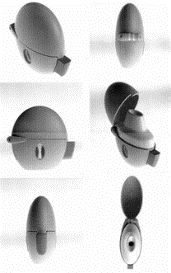
EUTM 001243484
The application for declaration of invalidity of the above-mentioned trade mark was based, inter alia, on Article 7(1)(e)(ii) of the Regulation No 2017/1001, i.e. the absolute ground for refusal of registration, according to which signs which consist exclusively of the shape of the goods or any other characteristic of the goods necessary to obtain a technical effect shall not be registered.
The EUIPO Cancellation Division granted the application for a declaration of invalidity. The Board of Appeal subsequently dismissed the appeal. According to the Board of Appeal, the disputed trade mark in fact represented four essential elements, i.e. a container, a lid, a mouthpiece and a button, which were technically necessary elements of the disputed product. In addition, the Board of Appeal found that the overall convex shape could not be defined as the main decorative or aesthetic element to the extent that this could exclude the application of Article 7(1)(e)(ii) of Regulation 2017/1001, as the shape of the inhaler used was also necessary to achieve a technical effect.
The Court shared the view expressed by the Board of Appeal and dismissed the appeal. It first reminded that the Article 7(1)(e)(ii) cannot be applicable where the application for registration as a trade mark relates to a shape of goods in which a non-functional element, such as a decorative or imaginative element, plays an important role. That solution may, in that case, be incorporated without difficulty by the competitors of the mark’s proprietor in shapes which do not have the same non-functional element as that contained in the proprietor’s shape and which are therefore neither identical nor similar to that shape.
The General Court did not agree with the applicant’s argument that the convex shape of the inhaler is the main element that is distinguished by the fact that it is symmetrical or that it represents a particular design that has been distinguished by the awards attributed to ‘HandiHaler’. In the Court’s view the convex shape is not the major arbitrary element of the sign.
Summary
The General Court agreed with the Board of Appeal that, in the present case, the convex shape of the inhaler follows the contour of three essential features, namely the container, the lid and the button. Consequently, in the Court’s view, the mark consisted solely of the shape of the product (the inhaler), which was necessary to achieve a technical effect.

See more:
From the Turing Test to the 2024 Nobel Prize: How Artificial Intelligence Has Developed Over the Decades
From the Turing Test to the 2024 Nobel Prize: How Artificial Intelligence Has Developed Over the Decades This is the first article in a series of publications devoted to artificial intelligence. As a starting point, it is worth setting out the key stages in the...
Overview of CJEU case law from 2.03 to 13.03.2026
Kowalski v EUIPO – Hoyer (FLAMBIT – flambriks), Case T‑301/25– The case concerned opposition proceedings against the registration of an EU trade mark. – Mr Dariusz Kowalski filed an application for the registration of the following EU figurative sign FLAMBIT for goods...
Overview of CJEU case law from 16.02 to 27.02.2026
Opinion of Advocate General – 26 February 2026 – Verwertungsgesellschaft Wort (VG Wort) v TL, Case C‑840/24 – The request for a preliminary ruling was submitted by the Bundesgerichtshof (Federal Court of Justice, Germany) and concerns the interpretation of provisions...