

Overview of CJEU case law from 27.10 to 2.11.2025
Review of CJEU case law from 27/10 to 02/11/2025
- Homestar v EUIPO – General Sanitary (THERMATEC), Case T-611/24
– The case concerned proceedings concerning an opposition to the registration of a trademark due to the likelihood of confusion – importantly, a high level of consumer attention was found in the case.
– Homestar sp. z o. o. filed an EU word-figurative mark:  for goods in class 11 (including heat pumps) and for services in class 37 (including repair of heating systems);
– General Sanitary, SLU filed an opposition against the registration based on the earlier word-figurative trademark 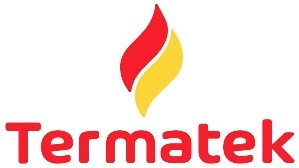 registered for goods in class 9 (including thermostats) and class 11 (including radiators).
– The Opposition Division upheld the opposition in its entirety.
– The Appeals Chamber dismissed the appeal. It found that the conflicting marks exhibit a high degree of visual similarity, are phonetically identical and that the degree of conceptual similarity has a limited impact because it is based on common elements with a low degree of distinctiveness.
– The CJEU dismissed the complaint. It agreed that there was a high level of consumer attention in the case, which could reduce the likelihood of confusion. However, it pointed out that this fact alone cannot exclude the finding that such a likelihood exists in the light of all the relevant factors of the present case, which include, inter alia, the phonetic identity and strong visual similarity of the signs at issue and the identity or similarity of the goods and services at issue.
Case details:
- Itron v EUIPO – Advanced Sanitairy Technologies (ITRON), Case T-565/24
– The case concerned proceedings concerning an opposition to the registration of a trademark.
– Itron, Inc. filed a word trademark application: ITRON for goods in class 9 (including electric extension cords), class 11 (including lamps), class 20 (including cable drums).
– Advanced Sanitairy Technologies filed an opposition against the registration of the above-mentioned mark based on earlier marks: ITRON in class 9 (including computer equipment) services in class 38 (including telecommunications); services in class 42 (scientific/technological services)
– The Opposition Division dismissed the opposition in respect of all goods.
– The Appeals Chamber dismissed the appeal. It pointed out that although the earlier mark might have been reputable, the goods and services belonged to completely different market segments, which made it impossible for the relevant public to establish a link between the conflicting marks.
– The CJEU upheld the complaint. It pointed out that the difference between the goods and services in question was not a sufficient factor to exclude the relevant public from establishing a link between the conflicting trademarks. The CJEU also pointed out that EUIPO had failed to assess at least the inherent distinctive character of the earlier trade mark.
Case details:
- Ningbo Vasa Intelligent Technology v EUIPO – Electronic Controls (Balises lumineuses), Case T-554/24
– The case concerned proceedings concerning the invalidation of the right to a design representing warning lights;
– Electronic Controls Co., is entitled to EU model representing warning lights:
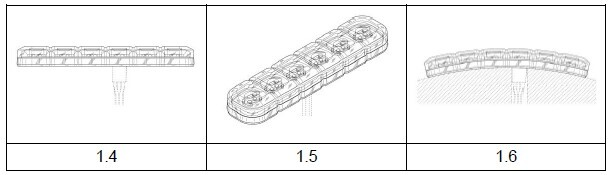
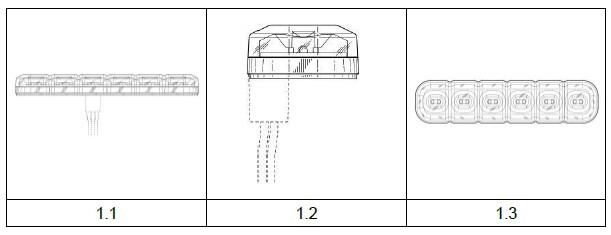
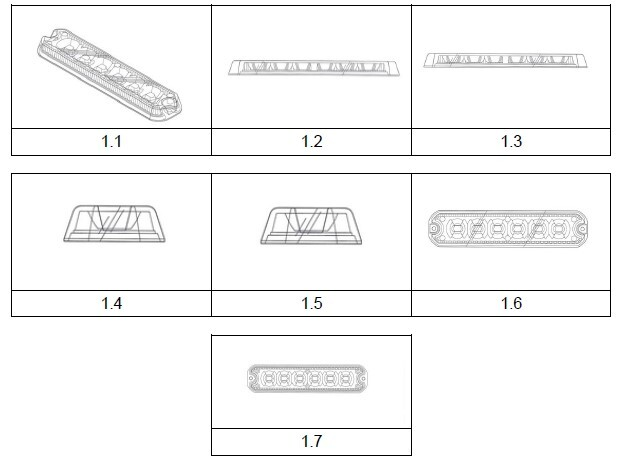
– Ningbo Vasa Intelligent Technology filed an invalidation application based on the argument that the contested design lacked individual character. In support of its argument, the applicant referred, among others, to the following earlier models:
– The Cancellation Board dismissed the invalidity application, finding that the earlier designs relied on by the applicant produced a different overall impression on the informed user.
– The Board of Appeal dismissed the appeal, arguing that the contested design was of individual character.
– The CJEU dismissed the complaint. It pointed out that the Board of Appeal had carried out a detailed and correct analysis, which showed that the designs produced a different impression.
Case details:
https://curia.europa.eu/juris/document/document.jsf?text=&docid=305630&pageIndex=0&doclang=EN&mode=lst&dir=&occ=first&part=1&cid=9498218, similar case also under file reference: T-550/24 – https://curia.europa.eu/juris/document/document.jsf?text=&docid=305629&pageIndex=0&doclang=EN&mode=lst&dir=&occ=first&part=1&cid=9498218
- European Lotto and Betting v EUIPO – Multi-State Lottery Association (Powerball), Case T-375/24
– The case concerned proceedings concerning the invalidation of trademark rights on grounds of bad faith.
– Multi-State Lottery Association filed word mark Powerball for services in Class 35 (including commercial research analysis), Class 41 (including education and entertainment), Class 42 (including design services). The mark was subsequently registered and transferred to Lottoland, Cavour Limited and then to European Lotto and Betting ltd.
– The Multi-State Lotteries Association filed a motion to set aside the lottery on the grounds of bad faith.
– The Cancellation Division granted the application.
– The Board of Appeal upheld the appeal regarding scientific services in class 42, and dismissed the appeal in the remaining respects. She pointed out that the objective circumstances of this case indicate bad faith on the part of the owner of the contested trademark at the time of filing the application for registration of that trademark.
– The CJEU dismissed the complaint. It agreed that the report was made in bad faith. The facts relevant to bad faith were as follows:
(i) The Lottoland Group knew that the US Multi-State Lottery Association had been running the Powerball lottery for years, yet it used the name to capitalise on its reputation.
(ii) The trademark application was filed by Tobias Roth, who acted as an intermediary on behalf of Lottoland, which demonstrates the concealment of the real applicant.
(iii) On the same day, applications were also filed to invalidate the earlier Powerball marks belonging to the US operator.
(iv) The registration was intended to block competitors from using the Powerball name, not to designate the origin of its own services.
Case details:
- Devin v EUIPO – Haskovo Chamber of Commerce and Industry (DEVIN), Case T-351/24
– The case concerned proceedings to invalidate a trademark due to its descriptive nature.
– Devin EAD filed the verbal registration DEVIN for goods in class 32 (including non-alcoholic beverages, mineral water).
– The Chamber of Commerce and Industry in Haskovo filed an application to invalidate the above-mentioned mark due to the descriptive nature of the goods. It pointed out that Devin is understood by the general public in Bulgaria and some recipients in neighbouring countries as a description of the geographical origin of the goods in question. (Devin is a city in Bulgaria, in the Smolyan region, near the border with Greece).
– The Invalidity Division of the EUIPO upheld the invalidity application.
– The Appeals Chamber dismissed the appeal.
– By judgment of 25 October 2018, Devin v EUIPO – Haskovo (DEVIN) (T‑122/17, EU:T:2018:719), the General Court annulled the decision of the Board of Appeal of 2 December 2016. The Court found that the Board of Appeal had made an error of assessment in finding that the contested trademark described the geographical origin for the average consumer in the countries neighbouring Bulgaria, namely Greece and Romania, and in all other Member States of the European Union.
– The Court then dismissed the appeal (C‑800/18 P, not published, EU:C:2019:606).
– The Board of Appeal annulled the decision of the Cancellation Division in so far as the contested trademark was declared invalid for „mineral water” in Class 32. With respect to the remaining goods, the Board of Appeal upheld the decision of the Cancellation Division and invalidated the contested trademark.
– The applicant has provided relevant evidence of distinctive character acquired through the use of in relation to mineral water.
– The Board of Appeal then confirmed the validity of the contested trademark for goods in Class 32, namely „mineral water”.
– The CJEU dismissed the complaint. It pointed out that it was rightly found that the rightholder had not proved that the name “DEVIN” had become recognisable throughout the European Union as a designation for all its products. As a result, the trademark registration was rightly invalidated.
Case details:

See more:
Review of CJEU case law from 2.02.2026 to 6.02.2026
Judgment of 5 February 2026, EUIPO v Nowhere Co. Ltd, Case C‑337/22 P – The case concerned opposition proceedings relating to the application for registration of the EU figurative trade mark APE TEES: – On 30 June 2015, Mr Ye filed an application for an EU trade...
Review of CJEU case law from 26.01.2026 to 30.01.2026
Judgment – of 28 January 2026 – Montepelayo, SLU v. EUIPO, Case T-203/25– The case concerned opposition proceedings against the registration of an EU word mark. – Montepelayo, SLU filed an EU word mark application for TELOTRÓN for goods and services in Classes 5...
Review of CJEU case law from 19.01.2026 to 23.01.2026
Hesse v EUIPO – 19.01.2026 – Ferrari (TESTAROSSA), Case C‑597/25 P– The case concerned the procedure under Article 58a of the Statute of the Court of Justice for determining whether an appeal against a judgment of the General Court in EU trade mark proceedings should...