

Review of CJEU case law from 15.12.2025 to 21.12.2025
- Judgment – 18/12/2025 – Deity Shoes, Case C-323/24
– The case concerned preliminary questions regarding the novelty and individual character of EU designs and the impact of fashion trends on the above-mentioned conditions.
– Deity Shoes claims rights to several shoe designs that are largely based on components and options offered in the catalogues of Chinese trading companies, i.e. the colour, material and arrangement of buckles, laces and other decorative elements are often pre-defined by suppliers.
– The dispute revolves around the allegations that the models introduced to the market do not differ significantly from the catalogue designs and that any changes are of a secondary nature, which, in the opinion of the opponents, excludes the novelty and individual character protected by the design.
– The national court notes that the specific nature of the footwear market, such as price pressure and following fashion trends, limits the scope for manoeuvre of designers and reduces the economic incentive to introduce significant innovations.
– In practice, this translates into situations in which the company only selects and combines parts offered in catalogs, sometimes making only minimal modifications, instead of creating new design elements from scratch.
– The Court asked preliminary questions on four issues: whether design protection requires actual creative activity by the applicant; whether customisation of catalogue parts can give the design an individual character; whether a person limiting themselves to such customisations can be considered the creator of the design; and whether and how fashion trends limit creative freedom and influence the assessment of differences between designs.
– As a result, the court expects guidance to assess when adaptations based on suppliers’ catalogues fall within the scope of design protection and when they should be treated as lacking sufficient novelty or individuality, especially in the context of market constraints and fashion trends.
– The Court gave the following answer:
(i) in order to obtain the protection provided for a design, the owner of a design right or the creator of that design shall not be required to prove that the design, in addition to meeting the conditions of novelty and individual character, is the result of a minimal degree of creativity.
(ii) first, the fact that the designs have features of appearance predetermined on the basis of the model offered to the designer of those designs in the supplier’s catalogue and that the changes made by that designer to those designs are only minor and concern the components offered by that supplier, cannot be regarded, in itself, as constituting an obstacle to recognition of the individual character of those designs within the meaning of Article 1668 of that same regulation. 6. Secondly, fashion trends must not restrict the designer’s degree of freedom in such a way that slight differences between one or more earlier designs and the contested design may be sufficient for the latter design to produce a different overall impression on the informed user from that produced by those earlier designs and therefore to have an individual character. The design features resulting from such trends cannot be of less importance to the overall impression that the design makes on such a user.
Case details:
- Judgment – 18/12/2025 – PMJC, Case C-168/24
– The case concerned preliminary ruling questions on issues such as a trademark corresponding to the name of a fashion designer and the risk of misleading the public as a result of using the trademark. The preliminary question concerns in particular the revocation of rights to a trade mark (Article 20(b) of Directive 2015/2436) where, as a result of the use of the trade mark by the proprietor or with the proprietor’s consent, there is a risk of misleading the public in relation to the goods or services for which it was registered.
– The company [W] [X], founded by the designer [W] [X], operated in the field of selling clothing and accessories, but was subsequently subject to bankruptcy proceedings. As a result, PMJC acquired all of its assets, including trademarks consisting of the surname [W] [X].
– After taking over the assets of [W], [X] continued to cooperate with PMJC for some time under a services agreement.
– After the end of this cooperation, PMJC filed a lawsuit against [W] [X], accusing him of infringing the rights to the acquired trademarks and committing acts of unfair and parasitic competition in connection with the activities conducted through the company [X] Créative.
– [W] [X] filed a counterclaim, seeking a declaration of revocation of PMJC’s rights to trademarks containing his name, pointing to the deliberately misleading use of these trademarks. According to it, the way they were used suggested to recipients that he was still involved in the design of the goods marked with them.
– The Paris Court of Appeal found that PMJC’s rights to some of the trademarks had expired because their use effectively led to the belief in the minds of the public that [W] [X] was still creatively involved or at least created a serious risk of such deliberate confusion.
– This assessment was strengthened by the fact that PMJC had previously been subject to final judgments finding infringement of the copyrights of [W] [X], and that goods bearing his name were presented as his original designs, despite the lack of such authorship.
– PMJC filed a cassation appeal, arguing that the mere creation of a belief in the designer’s involvement should not lead to the revocation of a trademark consisting of his name, even if the designer is no longer actually involved in the design.
– The Court of Cassation had doubts as to the interpretation of EU law and referred a question for a preliminary ruling as to whether it was possible to declare a trademark containing the surname [W] [X] revoked if, after its transfer, the trademark was used in a way that effectively suggested to the public that [W] [X] was still involved in the design of goods, although in fact this was not the case.
– The Court stated that a trademark cannot be allowed to become an unfair tool for attracting customers as a result of its use. It then gave the following answer:
(i) Article 20(b) of Directive 2015/2436 does not preclude revocation of a trade mark consisting of the name of a fashion designer on the ground that, in the light of all the relevant circumstances, use of that trade mark by the proprietor or with his consent is likely to lead the average consumer, who is reasonably well-informed and reasonably observant and circumspect, to mistakenly believe that that designer was involved in the design of the goods bearing that trade mark.
Case details:
- Judgment – 17/12/2025 – Freixenet v EUIPO – Alvear (CB), Case T-222/25
– The case concerned proceedings concerning an opposition to the registration of a trademark.
– Freixenet, SA has filed an EU figurative trademark application:  for goods in class 33 of the Nice Classification for sparkling wines.
– Alvear, SA, filed an opposition based on the earlier Spanish word mark CB registered for wines, spirits and liqueurs in Class 33.
– The basis for the objection was the likelihood of misleading consumers.
– The Opposition Division and then the Board of Appeal indicated that there was a risk of misleading the public.
– The EU Court dismissed the complaint. It pointed out that there was identity of goods and that the conflicting trademarks showed a high degree of visual similarity, were phonetically identical and could not be compared conceptually.
Case details:
- Judgment – 17/12/2025 – Transportes Centrais de Vergadela v EUIPO – Indra Sistemas (iTEC SKYNEX), Case T-58/25
– The case concerned proceedings concerning an opposition to the registration of a trademark.
– Indra Sistemas, SA filed an EU word mark application: iTEC SKYNEX for goods in class 39 (including air traffic monitoring services).
– Transportes Centrais de Vergadela, Unipessoal Lda. filed an opposition based on the earlier Portuguese word mark SKYNET registered for goods in Class 39 (rapid international transport services).
– The basis for the objection was the likelihood of misleading consumers.
– The Opposition Division upheld the opposition.
– The Board of Appeal upheld the appeal, citing the lack of likelihood of confusion.
– The EU Court upheld the complaint. It pointed out that the Board of Appeal had failed to fulfil its obligation to state reasons because it had included contradictory statements in its reasoning as to whether Portuguese consumers understood the English word „sky”.
Case details:
- Judgment – 17/12/2025 – Schöffel Sportbekleidung v EUIPO – BV (Schöffel Ich bin raus.), Case T-536/24
– The case concerned trademark revocation proceedings.
– Schöffel Sportbekleidung GmbH is entitled to the following word and figurative trademark,  registered for goods in classes 18 and 25.
– BV filed an application for the expiry of the above-mentioned mark.
– The Opposition Division found that the application constituted an abuse, but the Board of Appeal upheld the appeal.
– The EU Court dismissed the complaint. Although numerous extinguishment proceedings were pending between the parties, the Court noted that, given the fact that many of the applications were at least partially granted, the extinguishment proceedings pursued a legitimate aim.
Case details:
- Judgment – 17/12/2025 – Neoperl v EUIPO (Représentation d´un insert sanitaire cylindrique), Case T-487/21 RENV
– The case concerned proceedings concerning the refusal to register a mark due to a lack of distinctive character.
– Neoperl AG has filed the following three-dimensional trademark: 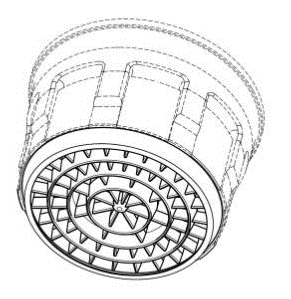 for goods in class 11 (Sanitary articles, in particular aerators and flow shapes). The sign actually represented a „tactile position marker.”
– The registration application was rejected. The basis for the rejection was that „tactile marks… are not generally accepted by the EUIPO.” Therefore, the applicant was advised to change the name of the applied-for mark to a “position mark”.
– The applicant insisted on classifying the trademark as a tactile mark.
– The Registration Division and the Board of Appeal indicated that the trademark applied for was devoid of distinctive character.
– The EU Court dismissed the complaint. The tactile impression of the applied-for trademark was insufficient to distinguish the applicant’s goods from those of its competitors.
Case details:

See more:
Overview of CJEU case law from 2.03 to 13.03.2026
Kowalski v EUIPO – Hoyer (FLAMBIT – flambriks), Case T‑301/25– The case concerned opposition proceedings against the registration of an EU trade mark. – Mr Dariusz Kowalski filed an application for the registration of the following EU figurative sign FLAMBIT for goods...
Overview of CJEU case law from 16.02 to 27.02.2026
Opinion of Advocate General – 26 February 2026 – Verwertungsgesellschaft Wort (VG Wort) v TL, Case C‑840/24 – The request for a preliminary ruling was submitted by the Bundesgerichtshof (Federal Court of Justice, Germany) and concerns the interpretation of provisions...
Review of CJEU case law from 2.02.2026 to 6.02.2026
Judgment of 5 February 2026, EUIPO v Nowhere Co. Ltd, Case C‑337/22 P – The case concerned opposition proceedings relating to the application for registration of the EU figurative trade mark APE TEES: – On 30 June 2015, Mr Ye filed an application for an EU trade...